
Comprehensive Guide to Negros Occidental
Negros Occidental is a province on Negros Island in the central Philippines. Since June 2024 it has been part of the new Negros Island Region (NIR), and its capital is Bacolod, a highly urbanized city that is counted separately from the province. The 2024 census counted 2,680,477 people in the province (3,305,264 with Bacolod), and the economy is built on sugar, with Bacolod as the region's main business and services hub.
- Region
- Negros Island Region (NIR), created by Republic Act No. 12000 in June 2024 (previously Western Visayas, Region VI)
- Capital
- Bacolod City (highly urbanized city, independent of the provincial government)
- Population (2024 census)
- 2,680,477 excluding Bacolod; 3,305,264 including Bacolod (624,787)
- Cities and municipalities
- 12 component cities and 19 municipalities, plus Bacolod as a highly urbanized city
- Land area
- 792,607 hectares (provincial government figure)
- Provincial economy (2025)
- PHP 288.27 billion, up 4.2% (PSA estimate, excludes Bacolod)
- Main airport
- Bacolod–Silay Airport
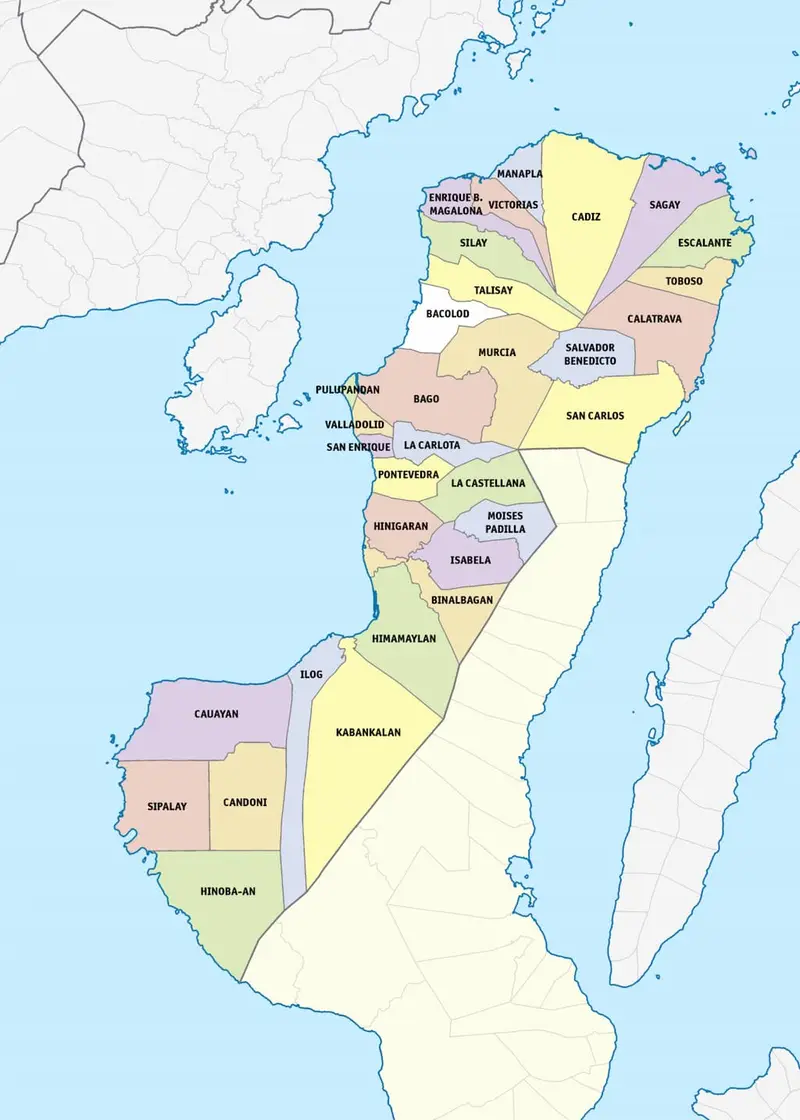
Negros Occidental at a glance
Negros Occidental is on Negros Island in the central Philippines, which it shares with Negros Oriental. Bacolod, the province’s largest city, became the provincial capital in 1849, and the provincial government is still based there.
For statistics and administration there are two layers to keep in mind:
- The province: 12 component cities and 19 municipalities, run by the provincial government.
- Bacolod City: a highly urbanized city. It is the provincial capital and sits inside the province’s borders, but it governs itself, and the Philippine Statistics Authority (PSA) reports its population and economic output separately.
This guide gives both figures wherever the difference matters. Bacolod adds roughly 625,000 people to any “Negros Occidental” total.
Negros Island Region: what changed in 2024
Republic Act No. 12000, the Negros Island Region Act, was approved on June 11, 2024 (the signing was reported on June 13). It created a new administrative region made up of Negros Occidental (including Bacolod City), Negros Oriental and Siquijor. Until then, Negros Occidental and Bacolod belonged to Western Visayas (Region VI), and Negros Oriental belonged to Central Visayas. The law does not name a regional center.
Government statistics now follow the new boundaries. The 2024 census results and the PSA’s 2024 and 2025 regional accounts report the Negros Island Region separately from Western Visayas.
Population (2024 census)
The 2024 Census of Population counted people as of July 1, 2024, and became official through Proclamation No. 973, signed on July 11, 2025. For the Negros Island Region, the results were:
| Area | Population (2024 census) |
|---|---|
| Negros Island Region (total) | 4,904,944 |
| Negros Occidental (excluding Bacolod) | 2,680,477 |
| Bacolod City (highly urbanized city) | 624,787 |
| Negros Occidental including Bacolod | 3,305,264 |
| Negros Oriental | 1,492,038 |
| Siquijor | 107,642 |
The province grew from 3,223,955 in the 2020 census to 3,305,264 in 2024, counting Bacolod.
Cities of Negros Occidental
| City | Population (2020 census) | Population (2024 census) |
|---|---|---|
| Bacolod (highly urbanized) | 600,783 | 624,787 |
| Kabankalan | 200,198 | 210,893 |
| Bago | 191,210 | 192,993 |
| Cadiz | 158,544 | 161,558 |
| Sagay | 148,894 | 152,543 |
| Silay | 130,478 | 136,802 |
| San Carlos | 132,650 | 133,175 |
| Himamaylan | 116,240 | 117,286 |
| Talisay | 108,909 | 109,204 |
| Escalante | 96,159 | 97,050 |
| Victorias | 90,101 | 90,290 |
| Sipalay | 72,448 | 73,847 |
| La Carlota | 66,664 | 67,740 |
Of the municipalities, Cauayan has the largest population, at 110,899 in 2024.
Economy
Sugar remains the base of the economy. The provincial government calls Negros Occidental the sugar capital of the Philippines. In July 2026 The Philippine Star reported that the Negros Island Region accounts for about 65 percent of national sugar production. The provincial investment office names Victorias Milling Company, First Farmers, Hawaiian-Philippine and Lopez Sugar among the main mills. Farming is exposed to the weather: PSA figures for 2024 showed agriculture, forestry and fishing output down 10.1 percent.
Economic output. The PSA’s provincial and regional accounts, as reported by the Philippine News Agency in October 2026, show:
| Economy | 2024 | 2025 | Growth in 2025 |
|---|---|---|---|
| Negros Occidental (excluding Bacolod) | PHP 276.68 billion | PHP 288.27 billion | 4.2% |
| Bacolod City | PHP 157.22 billion | PHP 167.92 billion | 6.8% |
| Negros Island Region | PHP 635.47 billion | PHP 671.68 billion | 5.7% |
BusinessWorld reported that the Negros Island Region’s 5.7 percent growth in 2025 was the joint second-fastest among the country’s 18 regions, level with Caraga and behind Western Visayas. In 2024 the province’s fastest-growing industry was construction, up 20.3 percent, and its per-capita output was PHP 104,438.
Services and investment zones. The Philippine News Agency describes Bacolod as the region’s main business, finance and services hub. The provincial investment office counts 25 PEZA-registered economic zones in the province, 15 operating and 10 proclaimed, including IT parks, agro-industrial zones and manufacturing hubs. It also names Talisay City as a center for skilled workers. The same office reported PHP 7.9 billion in tourist receipts for 2024.
Getting there and getting around
- Air: Bacolod–Silay Airport (BCD) is the main gateway. The provincial investment office puts it about 15 km from Bacolod City, with flights to Manila, Cebu, Clark, Davao and Cagayan de Oro.
- Sea: Bacolod’s Banago and BREDCO ports are the city’s main entry points for vessels. The province also lists ports at San Carlos, Escalante, Pulupandan and Cadiz.
Cities to know
Bacolod
Bacolod is the capital and the largest city, with 624,787 residents in 2024. The city government gives its land area as 162.67 km² and lists the Banago and BREDCO ports as its entry points for vessels. Its economy reached PHP 167.92 billion in 2025, up 6.8 percent. The city holds the MassKara Festival in October.
Talisay and Silay
Talisay had 109,204 people in 2024 and Silay had 136,802. The provincial investment office describes Talisay as a center for skilled workers. Both are among the cities where Lionunion has listings.
Victorias
Victorias (90,290 people in 2024) is home to Victorias Milling Company, which the provincial investment office lists among the province’s main sugar mills.
Kabankalan and the south
Kabankalan is the largest component city by population, with 210,893 people in 2024, up from 200,198 in 2020. In percentage terms it grew faster than any other city in the province over that period.
What has changed since 2023
- New region (June 2024): Under Republic Act No. 12000, Negros Occidental and Bacolod left Western Visayas and became part of the Negros Island Region, together with Negros Oriental and Siquijor.
- New census (official July 2025): The 2024 census replaced the 2020 figures. The province now has 2,680,477 people without Bacolod, or 3,305,264 with it.
- Separate regional statistics: Starting with the 2024 data, the PSA publishes economic accounts for the Negros Island Region separately from Western Visayas. The region grew 5.7 percent in 2025.
Property in Negros Occidental
Bacolod is the largest city and, according to the Philippine News Agency, the region’s main business, finance and services hub. Kabankalan, Bago, Cadiz and Sagay each had more than 150,000 residents in 2024.
Some points of reference for buyers:
- Bacolod is a highly urbanized city with its own city government, separate from the provincial government of Negros Occidental.
- Construction was the province’s fastest-growing industry in 2024, up 20.3 percent according to the PSA.
- Bacolod’s 2025 output growth (6.8 percent) was faster than the rest of the province (4.2 percent).
Lionunion lists properties in Negros Occidental, including Bacolod, Talisay, Silay and Victorias. The Western Visayas listing page covers the region the province belonged to until 2024 (see also our Western Visayas overview). For how regions, provinces and cities fit together, see the guide to the administrative divisions of the Philippines.
Browse our Negros Occidental listings or contact Lionunion to ask about a property in Bacolod or elsewhere in the province.
Frequently asked questions
What region is Negros Occidental in?
Negros Occidental is part of the Negros Island Region (NIR), created by Republic Act No. 12000 in June 2024. The region also includes Negros Oriental, Siquijor and Bacolod City. Before that, the province belonged to Western Visayas (Region VI).
What is the capital of Negros Occidental?
Bacolod City is the capital, and the provincial government is based there. Bacolod is a highly urbanized city, so it runs its own affairs and statistics list it separately from the province.
What is the population of Negros Occidental?
The 2024 census counted 2,680,477 people in Negros Occidental without Bacolod. With Bacolod's 624,787 included, the total is 3,305,264.
How many cities are in Negros Occidental?
There are 13 cities if Bacolod is counted, or 12 component cities without it. The province also has 19 municipalities.
What is Negros Occidental known for?
Sugar. The provincial government calls the province the sugar capital of the Philippines, and the Negros Island Region accounts for about 65 percent of the country's sugar production. Bacolod also hosts the MassKara Festival every October.
Is Bacolod part of Negros Occidental?
Geographically, yes, and it is the provincial capital. Administratively, Bacolod is a highly urbanized city independent of the provincial government, and its population and economic output are reported separately.
Sources
- Philippine Standard Geographic Code (PSGC), with population from the 2024 Census of Population (provinces, cities and municipalities), Philippine Statistics Authority
- Republic Act No. 12000 (Negros Island Region Act), Lawphil Project (Arellano Law Foundation), June 11, 2024
- Marcos signs law creating new Negros Island Region, The Philippine Star, June 13, 2024
- Proclamation No. 973, s. 2025 (2024 Census of Population declared official), Lawphil Project (Arellano Law Foundation), July 11, 2025
- NIR population 4.9M, 2nd highest in Visayas, DigiCast Negros, July 24, 2025
- Negros Island (region) – population statistics (PSA census data), City Population (Thomas Brinkhoff), compiling Philippine Statistics Authority data
- Negros Occidental – cities and municipalities (PSA census data), City Population (Thomas Brinkhoff), compiling Philippine Statistics Authority data
- Why invest in Negros Occidental, Provincial Government of Negros Occidental (PEDIC)
- Invest Negros Occidental (Governor's message), Provincial Government of Negros Occidental
- The History & Geography, Provincial Government of Negros Occidental
- Quick Facts, City Government of Bacolod
- Strong secondary growth centers vital to dev't of Negros Island Region, Philippine News Agency, October 16, 2026
- NCR economy grows 4.4% in 2025, weakest in 5 years, BusinessWorld, April 23, 2026
- Negros Occidental economy expands 5.1 percent in 2024, Daily Guardian, October 11, 2025
- Pest attack continues to threaten sugar industry, The Philippine Star, July 12, 2026