
Comprehensive Guide to Misamis Oriental
Misamis Oriental is a province on the north-central coast of Mindanao in Northern Mindanao (Region X). Its capital is Cagayan de Oro, a highly urbanized city that is governed separately and counted separately: the province had 988,065 people in the 2024 census, or 1,729,682 including Cagayan de Oro's 741,617. The province's economy grew 5.9% in 2024, and Cagayan de Oro is the region's largest economy and main trade and services hub.
- Region
- Northern Mindanao (Region X)
- Capital
- Cagayan de Oro (a highly urbanized city, independent of the province)
- Population (2024 census)
- 988,065 excluding Cagayan de Oro; 1,729,682 including Cagayan de Oro (741,617)
- Land area
- 3,131.52 km² excluding Cagayan de Oro (PSA 2013 figure)
- Cities and municipalities
- 2 component cities (El Salvador, Gingoog) and 23 municipalities; 424 barangays
- Economic growth (2024)
- Province 5.9%; Cagayan de Oro 6.8% (PSA)
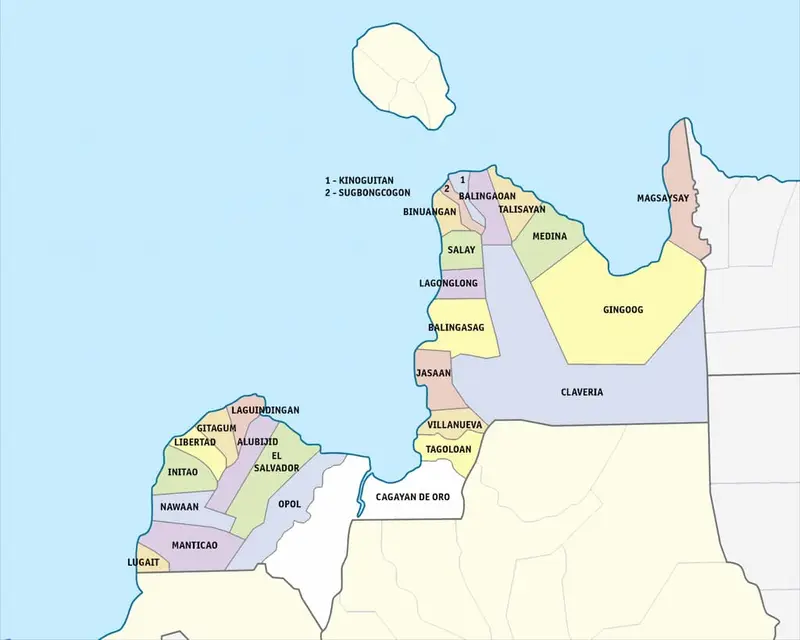
Misamis Oriental at a glance
Misamis Oriental occupies the north-central coast of Mindanao and belongs to Northern Mindanao (Region X), one of the administrative regions of the Philippines. Executive Order No. 36 of September 2001, which set the current regional line-up in Mindanao, lists Misamis Oriental alongside Bukidnon, Camiguin, Lanao del Norte and Misamis Occidental as the region’s provinces.
The province faces Iligan Bay, the Bohol Sea, Macajalar Bay and Gingoog Bay. On land it borders Agusan del Norte and Agusan del Sur to the east, Bukidnon to the south and Lanao del Norte to the west.
Its capital is Cagayan de Oro, which is also the regional center of Northern Mindanao.
How Cagayan de Oro is counted
Cagayan de Oro is a highly urbanized city. In the Philippines, that status means the city is administered independently of the province around it, and government statistics report it on its own line. So there are two ways to give the population of Misamis Oriental, and both are correct as long as the basis is stated:
- Province only (excluding Cagayan de Oro): 988,065 (2024 census)
- Whole geographic area (including Cagayan de Oro): 1,729,682 (2024 census)
The same applies to land area and barangay counts. The province covers 3,131.52 km² and 424 barangays without Cagayan de Oro. The city adds about 412.80 km² and 80 barangays (PSA area figures from 2013).
The 2024 Census of Population was taken with a reference date of 1 July 2024. President Marcos declared its results official through Proclamation No. 973, dated 11 July 2025. The census put the national population at 112,729,484 and Northern Mindanao at 5,178,326.
Population by city and municipality
Between the 2020 census (1 May 2020) and the 2024 census (1 July 2024), the province excluding Cagayan de Oro grew by 31,165 people, or about 3.3%. Cagayan de Oro grew by 13,215, or about 1.8%.
| City / municipality | Type | 2020 census | 2024 census |
|---|---|---|---|
| Cagayan de Oro | Highly urbanized city (independent) | 728,402 | 741,617 |
| Gingoog | Component city | 136,698 | 138,895 |
| Tagoloan | Municipality | 80,319 | 80,424 |
| Balingasag | Municipality | 74,385 | 76,877 |
| Opol | Municipality | 66,327 | 66,836 |
| El Salvador | Component city | 58,771 | 62,126 |
| Jasaan | Municipality | 57,055 | 58,098 |
| Claveria | Municipality | 52,478 | 52,718 |
| Villanueva | Municipality | 40,419 | 42,456 |
| Magsaysay | Municipality | 36,803 | 37,084 |
| Medina | Municipality | 35,612 | 36,692 |
| Alubijid | Municipality | 32,163 | 35,411 |
| Initao | Municipality | 33,902 | 34,445 |
| Salay | Municipality | 29,998 | 31,128 |
| Manticao | Municipality | 29,469 | 30,968 |
| Laguindingan | Municipality | 26,363 | 27,688 |
| Talisayan | Municipality | 25,761 | 26,801 |
| Lagonglong | Municipality | 24,190 | 25,072 |
| Naawan | Municipality | 22,444 | 23,562 |
| Lugait | Municipality | 20,559 | 20,946 |
| Gitagum | Municipality | 17,920 | 19,269 |
| Kinoguitan | Municipality | 14,091 | 15,763 |
| Libertad | Municipality | 12,948 | 13,461 |
| Balingoan | Municipality | 11,020 | 11,896 |
| Sugbongcogon | Municipality | 9,764 | 11,156 |
| Binuangan | Municipality | 7,441 | 8,293 |
| Province, excluding Cagayan de Oro | 956,900 | 988,065 | |
| Including Cagayan de Oro | 1,685,302 | 1,729,682 |
Economy
The Philippine Statistics Authority (PSA) measures the economies of provinces and highly urbanized cities separately, in the same way it counts their populations. According to PSA figures reported in November 2025:
- Northern Mindanao grew 6.0% in 2024, reaching ₱1.04 trillion at constant 2018 prices, up from ₱984.17 billion in 2023. Services and construction led the growth.
- Cagayan de Oro grew 6.8% in 2024 and produced ₱295.6 billion at constant 2018 prices, or 28.3% of the region’s output. That makes it the region’s largest single economy. The PSA regional director linked its growth to trade, services and infrastructure investment.
- Misamis Oriental (province) grew 5.9% in 2024, with gains in services and industry.
The province’s largest industrial zone is the PHIVIDEC Industrial Estate, about 3,000 hectares in Tagoloan and Villanueva on Macajalar Bay. Proclamation No. 2106 of 2010 designated the whole estate a special economic zone.
Cities and towns to know
Cagayan de Oro
Cagayan de Oro is the province’s capital, the regional center of Northern Mindanao and its most populous city (741,617 in the 2024 census). It sits on Macajalar Bay, with Opol the nearest town to the west-northwest and Tagoloan to the east-northeast, and it has 80 barangays. In 2024 it produced 28.3% of Northern Mindanao’s economic output.
Gingoog
Gingoog is the larger of the province’s two component cities, with 138,895 residents in the 2024 census and a land area of 568.44 km².
El Salvador
El Salvador became a component city under Republic Act No. 9435 of April 2007. It had 62,126 residents in the 2024 census, up from 58,771 in 2020, and covers 106.15 km².
Opol
Opol is Cagayan de Oro’s nearest neighbour to the west-northwest and had 66,836 residents in the 2024 census, on a land area of 175.13 km².
Initao
Initao had 34,445 residents in the 2024 census and covers 111.27 km².
Balingasag
Balingasag had 76,877 residents in the 2024 census and covers 147.11 km².
Tagoloan and Villanueva
These two neighbouring towns share the PHIVIDEC Industrial Estate. Tagoloan had 80,424 residents and Villanueva 42,456 in the 2024 census.
Getting there
Laguindingan International Airport, in Misamis Oriental, serves Cagayan de Oro, Iligan and the provinces of Misamis Oriental, Lanao del Norte and Bukidnon. It opened in June 2013, replacing the old Lumbia Airport in Cagayan de Oro. The government awarded a concession to run and upgrade it to Aboitiz InfraCapital in 2024. As of April 2026, the operator reported that airside upgrades, including new apron markings, were under way.
What has changed since 2023
- New census figures (declared official July 2025). The 2024 census replaces the 2020 figures. The province (excluding Cagayan de Oro) went from 956,900 to 988,065, and Cagayan de Oro from 728,402 to 741,617.
- Income classes were reset (effective 2025). Republic Act No. 11964, approved on 26 October 2023, requires income classes of provinces, cities and municipalities to be recalculated every three years. The Department of Finance issued the first new schedule as Department Order No. 074-2024 in November 2024. Income classes quoted in older guides (for example “1st class” or “3rd class”) may no longer apply. Check the current Department of Finance schedule before relying on one.
- Airport operator changed. Laguindingan International Airport moved to private operation under the concession awarded in 2024, with upgrade works starting in 2025.
- No boundary changes. No new cities or municipalities were created in Misamis Oriental between 2023 and November 2026 in the sources reviewed. The province still has two component cities and 23 municipalities.
Property in Misamis Oriental
Cagayan de Oro is the area’s largest population and economic centre, but it is only part of the picture. Population figures are worth checking when choosing a location. Between 2020 and 2024, Cagayan de Oro grew more slowly (about 1.8%) than the rest of the province combined (about 3.3%). Among larger towns, Alubijid and El Salvador grew faster than Opol or Tagoloan.
Points for buyers to keep in mind:
- Know which local government you are buying in. Cagayan de Oro is administered separately from the province. A property in Opol or El Salvador falls under a different set of local offices from one in Cagayan de Oro, even if it is only a few kilometres away.
- Check the licence to sell. The Department of Human Settlements and Urban Development (DHSUD) advises buyers to confirm that a project has a valid licence to sell before buying. Ask the seller for the licence number or a copy, and check it against DHSUD’s License to Sell Directory.
Current listings by area:
- Misamis Oriental (all listings in the province)
- Cagayan de Oro
- Opol
- Initao
- Balingasag
- Gingoog
- Northern Mindanao region
- Northern Mindanao: a comprehensive overview
For neighbouring areas, see the guides to Lanao del Norte, Caraga and the Bangsamoro region.
Browse our current Misamis Oriental and Cagayan de Oro listings above, or contact Lionunion for help finding a property in Northern Mindanao.
Frequently asked questions
What is the capital of Misamis Oriental?
Cagayan de Oro is the capital. It is a highly urbanized city, so it is administered independently of the province and its population is reported separately from the provincial total.
What is the population of Misamis Oriental?
The 2024 census counted 988,065 people in the province excluding Cagayan de Oro. Adding Cagayan de Oro's 741,617 gives 1,729,682 for the whole geographic area.
What is the population of Cagayan de Oro?
Cagayan de Oro had 741,617 residents in the 2024 census, up from 728,402 in the 2020 census.
How many cities are in Misamis Oriental?
The province has two component cities, El Salvador and Gingoog, plus 23 municipalities. Cagayan de Oro lies within the province geographically but is a separate highly urbanized city.
Which airport serves Cagayan de Oro?
Laguindingan International Airport in Misamis Oriental serves Cagayan de Oro, Iligan and the surrounding provinces. It is run under a government concession awarded to Aboitiz InfraCapital in 2024.
How fast is the Misamis Oriental economy growing?
PSA data reported in November 2025 show the province grew 5.9% and Cagayan de Oro grew 6.8% in 2024, against 6.0% for Northern Mindanao as a whole.
Sources
- Philippine Standard Geographic Code (PSGC), with population from the 2024 Census of Population (provinces, cities and municipalities), Philippine Statistics Authority
- Misamis Oriental (Province, Philippines) with population statistics, by city and municipality, City Population (compiled from Philippine Statistics Authority census results)
- Northern Mindanao (Region, Philippines): provinces with population statistics, City Population (compiled from Philippine Statistics Authority census results)
- PH population reaches 112.7-M —PSA, PTV News, July 17, 2025
- Proclamation No. 973, s. 2025 (declaring the 2024 Census of Population official), Lawphil (Arellano Law Foundation), text of the Office of the President issuance, July 11, 2025
- CDO drives 6% economic growth of N. Mindanao, Philippine Daily Inquirer, November 7, 2025
- Misamis Oriental Profile, PhilAtlas (citing Philippine Statistics Authority)
- Cagayan de Oro City Profile, PhilAtlas (citing Philippine Statistics Authority)
- Republic Act No. 9435, Charter of the City of El Salvador, Lawphil (Arellano Law Foundation), April 12, 2007
- Executive Order No. 36, s. 2001 (reorganization of the administrative regions in Mindanao), Lawphil (Arellano Law Foundation), September 19, 2001
- Republic Act No. 11964, Automatic Income Classification of LGUs Act, Lawphil (Arellano Law Foundation), October 26, 2023
- Cebu province now has 25 first-class towns, two first-class cities, Daily Tribune, December 9, 2024
- Laguindingan undergoes reliability, safety boosts, Daily Tribune, April 6, 2026
- DHSUD urges homebuyers to verify project license to sell, SunStar, September 8, 2026
- Proclamation No. 2106, s. 2010 (PHIVIDEC Industrial Estate as Special Economic Zone), Lawphil (Arellano Law Foundation), June 29, 2010