
Comprehensive Guide to Laguna
Laguna is a province in Calabarzon (Region IV-A), the region just south and east of Metro Manila, and takes in the largest part of the Laguna de Bay basin, the country's largest inland body of water. Its capital is Santa Cruz, and it had about 3.69 million people in the 2024 census, the second most in Calabarzon and the fastest growth of the region's provinces. Its economy, worth PHP 1.14 trillion in 2025, was the largest of any Philippine province, led by industry and manufacturing in the economic zones of Biñan, Santa Rosa, Cabuyao and Calamba.
- Region
- Calabarzon (Region IV-A)
- Capital
- Santa Cruz
- Population (2024 census)
- 3,687,345; 2.09% a year growth in 2020–2024, fastest in Calabarzon
- Cities and municipalities
- 6 component cities (Biñan, Cabuyao, Calamba, San Pablo, San Pedro, Santa Rosa) and 24 municipalities
- Largest city
- Biñan, 584,479 (2024 census)
- Provincial GDP (2025)
- PHP 1.14 trillion, 4.9% of national GDP, the largest of any province
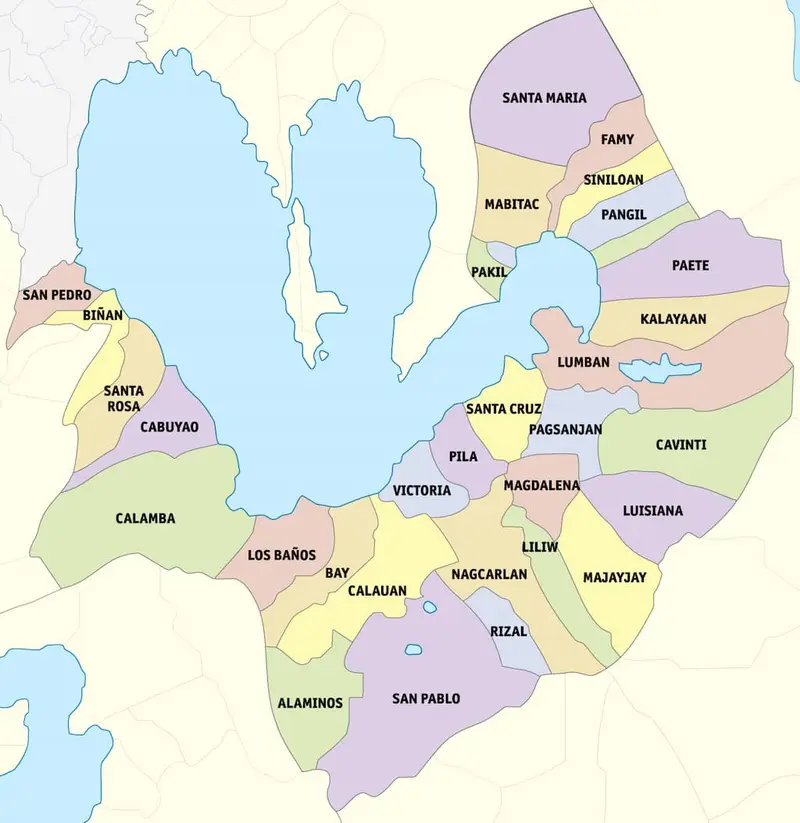
Laguna at a glance
Laguna is one of the five provinces of Calabarzon (Region IV-A), the region just south and east of Metro Manila in the Philippines. It is an inland province that takes in the largest part of the Laguna de Bay basin. The lake is the country’s largest inland body of water, and Laguna’s land ranges from flat lakeshore plains to steep uplands.
The provincial capital is Santa Cruz, where the provincial capitol stands on P. Guevarra Street. Laguna is made up of six component cities (Biñan, Cabuyao, Calamba, San Pablo, San Pedro and Santa Rosa) and 24 municipalities. Calamba is also the regional center of Calabarzon, under Executive Order No. 246 of 2003.
Population (2024 census)
Laguna had about 3.69 million people on 1 July 2024 (3,687,000 in the Philippine Statistics Authority’s rounded figures), up from 3.38 million in 2020. That makes it the second most populous province in Calabarzon after Cavite (4.57 million). It was also the region’s fastest-growing province between 2020 and 2024, at 2.09 percent a year.
Three Laguna cities are among Calabarzon’s ten most populous local government units: Biñan, Calamba and Santa Rosa. Every other Laguna city or town had fewer than 397,111 residents in 2024, the cut-off for the regional top ten.
| City / municipality | 2020 census | 2024 census | Barangays |
|---|---|---|---|
| Biñan (city) | 407,437 | 584,479 | 24 |
| Calamba (city) | 539,671 | 575,046 | 54 |
| Santa Rosa (city) | 414,812 | 430,920 | 18 |
| Cabuyao (city) | 355,330 | 365,202 | 18 |
| San Pedro (city) | 326,001 | 348,968 | 27 |
| San Pablo (city) | 285,348 | 300,166 | 80 |
| Santa Cruz (capital, municipality) | 123,574 | 126,844 | 26 |
| Los Baños (municipality) | 115,353 | 117,030 | 14 |
2024 figures are from the PSA’s regional census highlights, which name only the ten largest local government units in Calabarzon. 2020 census figures and barangay counts are from Rappler’s 2025 election profiles.
Economy
Laguna’s economy was worth PHP 1.14 trillion in 2025, up from PHP 1.08 trillion in 2024, according to PSA provincial accounts reported by the Inquirer. That was 4.9 percent of national GDP. It ranked third among all local economies, behind only Quezon City and Makati, and first among provinces. In 2024, Laguna was the only province with an economy above PHP 1 trillion.
The regional office of the Department of Economy, Planning, and Development (DEPDev) names Laguna, Cavite and Batangas as Calabarzon’s main economic drivers, supported by strong industry and services sectors. Their manufacturing industries anchor the region’s manufacturing output. Laguna’s farm, forestry and fishing output grew 20.4 percent in 2025, the fastest in the region, after shrinking 2.8 percent in 2024.
Much of that manufacturing sits in economic zones. A May 2026 Philippine Economic Zone Authority (PEZA) list of its zone sites includes:
- Biñan: Laguna Technopark and Laguna International Industrial Park
- Santa Rosa: Toyota Sta. Rosa Industrial Complex, Greenfield Automotive Park and IT centers/parks
- Cabuyao: Light Industry and Science Park of the Philippines
- Calamba: Light Industry and Science Park of the Philippines II, Carmelray Industrial Parks I and II, Filinvest Technology Park, YTMI Realty Special Economic Zone and Sagara Metro Plastics SEZ
Cities and towns
Biñan
Biñan became Laguna’s most populous city in the 2024 census (584,479), overtaking Calamba. PEZA lists two major ecozones under Biñan: Laguna Technopark and the Laguna International Industrial Park. It has 24 barangays.
Calamba
Calamba (575,046 in 2024) is the regional center of Calabarzon. The DEPDev regional office is in Barangay Milagrosa. It has 54 barangays and hosts several PEZA zones. It is also the planned southern end of two major projects: the Laguna Lakeshore Road Network from Taguig and the North-South Commuter Railway from Clark.
Santa Rosa
Santa Rosa had 430,920 people in 2024. Its PEZA sites include the Toyota Sta. Rosa Industrial Complex and Greenfield Automotive Park.
Cabuyao and San Pedro
Cabuyao (355,330 in 2020) hosts the first Light Industry and Science Park of the Philippines (LISP I). San Pedro is the smallest of the six cities by land area, at 24.05 sq km in Rappler’s profile, and had 326,001 people in 2020.
San Pablo
San Pablo is the largest of the six cities by land area (197.56 sq km in Rappler’s profile) and has the most barangays of any of them, at 80. It had 285,348 people in 2020.
Santa Cruz, Los Baños and the lakeshore towns
Santa Cruz, the capital, is a municipality of 26 barangays. Los Baños is home to the University of the Philippines Los Baños. On the eastern lakeshore, the provincial tourism office promotes the churches of Pila, Pakil, Paete, Kalayaan and Lumban on a pilgrimage route. It notes that Paete was declared the “Carving Capital of the Philippines” in 2005.
Infrastructure and hazards
- Laguna Lakeshore Road Network. In July 2026, Daily Tribune reported that construction had begun on this 45.5-km road linking Taguig and Calamba, after delays from design revisions and environmental and social impact studies.
- North-South Commuter Railway. The same report said the 147-km line from Clark to Calamba is hoped to begin partial operations in 2027, with full operations not expected until 2032. Right-of-way acquisition is the main cause of delay.
- Earthquake fault. The PHIVOLCS Valley Fault System Atlas, released in 2015, maps the West Valley Fault through barangays in San Pedro (including Calendola, GSIS, Sampaguita Village, San Antonio, San Vicente, Riverside and United Bayanihan), Biñan (Poblacion, Malamig and San Francisco), Santa Rosa (Santo Domingo), Cabuyao (Casile) and Calamba (Canlubang).
What has changed since 2023
- 2024 census (declared official July 2025). Laguna’s population rose to about 3.69 million, the fastest growth in Calabarzon. Biñan overtook Calamba as the largest city.
- A trillion-peso economy. Laguna passed PHP 1 trillion in provincial GDP and reached PHP 1.14 trillion in 2025, the largest of any province.
- Infrastructure milestones. Construction on the Laguna Lakeshore Road Network was reported under way in 2026. The North-South Commuter Railway’s partial opening is now targeted for 2027.
- No change in local government units. Laguna still has six cities and 24 municipalities.
Property in Laguna
Laguna’s three largest cities (Biñan, Calamba and Santa Rosa) and Cabuyao host the PEZA zones listed above. Lionunion also lists property in San Pedro, San Pablo, Los Baños, Bay, Calauan and the capital, Santa Cruz:
- All Laguna listings
- Cities: Calamba, Santa Rosa, Biñan, Cabuyao, San Pedro, San Pablo
- Municipalities: Santa Cruz, Los Baños, Bay, Calauan
- Nearby: all Calabarzon listings
Before buying, check three things. First, check the location against the PHIVOLCS fault and hazard maps, especially in the five cities the West Valley Fault crosses. Second, under Presidential Decree No. 957, a developer may not sell subdivision lots or condominium units without a license to sell, so ask to see the project’s registration and license. Third, overseas buyers should know that the Condominium Act (Republic Act No. 4726) limits unit transfers to non-Filipinos according to each project’s foreign-ownership limits.
Browse the Laguna listings above or contact Lionunion for help finding a home or investment property in the province.
Frequently asked questions
What is the capital of Laguna?
Santa Cruz, a municipality where the provincial capitol stands. Calamba, a city in Laguna, is the regional center of Calabarzon, not the provincial capital.
What is the population of Laguna?
About 3.69 million as of 1 July 2024, according to the 2024 Census of Population. Laguna is the second most populous province in Calabarzon after Cavite and grew fastest in the region, at 2.09 percent a year between 2020 and 2024.
How many cities are in Laguna?
Six component cities (Biñan, Cabuyao, Calamba, San Pablo, San Pedro and Santa Rosa) and 24 municipalities, for 30 local government units in all.
What is the largest city in Laguna?
Biñan, with 584,479 people in the 2024 census, just ahead of Calamba with 575,046. Santa Rosa, with 430,920, is third.
Why is Laguna's economy so large?
Laguna's economy reached PHP 1.14 trillion in 2025, 4.9 percent of national GDP and the largest of any province. DEPDev names Laguna, with Cavite and Batangas, as the region's main economic drivers, with manufacturing at the core.
Is Laguna near an earthquake fault?
Yes. PHIVOLCS's Valley Fault System Atlas maps the West Valley Fault through barangays in San Pedro, Biñan, Santa Rosa, Cabuyao and Calamba. Buyers should check a specific address against the PHIVOLCS maps.
Sources
- Philippine Standard Geographic Code (PSGC), with population from the 2024 Census of Population (provinces, cities and municipalities), Philippine Statistics Authority
- Highlights of the Region IV-A (CALABARZON) Population 2024 Census of Population (2024 POPCEN), Reference No. 2025-276, Philippine Statistics Authority, August 1, 2025
- Philippines population reached 112.7 million in 2024 – PSA, The Philippine Star, July 18, 2025
- Provincial Government of Laguna (home page and news), Provincial Government of Laguna
- 2025 local races – Biñan City, Rappler
- 2025 local races – Calamba City, Rappler
- 2025 local races – Santa Rosa City, Rappler
- 2025 local races – Cabuyao City, Rappler
- 2025 local races – San Pedro City, Rappler
- 2025 local races – San Pablo City, Rappler
- 2025 local races – Santa Cruz, Rappler
- 2025 local races – Los Baños, Rappler
- Physical and Socio-Economic Profile (Region IV-A), Department of Environment and Natural Resources (DENR) CALABARZON
- Executive Order No. 246, s. 2003 (designating Calamba City as regional center of Region IV-A), LawPhil Project, October 28, 2003
- PSA: Luzon still dominates Top 10 local economies in 2025, Philippine Daily Inquirer, August 31, 2026
- Four CL provinces among Top 10 GDP contributors, Daily Tribune, November 21, 2025
- DEPDev CALABARZON delivers statements on provincial and HUC economic performances, DEPDev Regional Office IV-A, October 7, 2026
- Request for Quotation BAC-2026-05-08 (list of PEZA economic zone sites), Philippine Economic Zone Authority, May 21, 2026
- Build Better More projects face delays, challenges, Daily Tribune, July 24, 2026
- LIST: Barangays in Metro Manila, nearby provinces near earthquake fault, GMA News, May 18, 2015
- University of the Philippines Los Baños (home page), University of the Philippines Los Baños
- Laguna Passport: Journey of Faith, Provincial Government of Laguna
- Presidential Decree No. 957 (Subdivision and Condominium Buyers' Protective Decree), LawPhil Project, July 12, 1976
- Republic Act No. 4726 (The Condominium Act), LawPhil Project, June 18, 1966